


Call for Papers until
November 28, 2025
Results announced from January 5, 2026
Registration: end of January to May 22, 2026
Rules for submitting abstracts
1) Fill in the following file:
> TEMPLATE DOCUMENT <
2) Submit the proposal using the
> FORM <

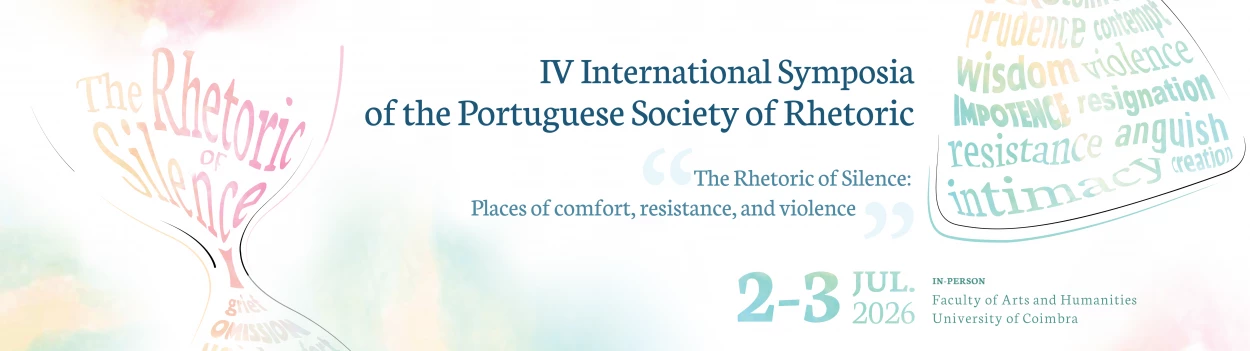
The Rhetoric of Silence: Places of comfort, resistance, and violence
What is the essence of silence? Is it possible to grasp it as a concept and theory? Common sense would say it is the simple absence of words or noise, emptiness, something intangible. How to explain the expression “keep silence,” different still from silentium facere (‘shutting up’, according to Titus Livius). Seneca stated that life’s tragedies teach us the art of silence, as if holding words in was synonymous with prudence and wisdom. Shakespeare too preferred to be king of his silence than slave of his words. Spinoza wished men had the same capabilities in silence that they possess during speech. Eugénio de Andrade claims we can spend everything but silence. Popular sayings also have something to say about silence: speech is silver, silence is golden or a good listener understands with half a word. Studies indicate that silence can account for between 30 and 50% of the time of a speech (political or otherwise) with all its pauses, suspensions, hesitations, and omissions. For the oppressed, silence can represent their powerlessness, resignation, and resistance; for the oppressors, it can convey violence and indifference. Silence is manifested differently in each of its semantic-pragmatic fulfilments: silence of fascination or spite, of relaxation or tension, of serenity or anguish, of rapprochement or detachment from others. Silence is a tool for accomplices and for the guilty. In times of disease, it means mourning; in times of war, it means death; in idyllic times, it means peace.
The Homeric poems may not be read without an awareness of how silenced and silent the female voices were. Telemachus’s refusal to hear Penelope out might well be the first example in Western literature of a man telling a woman to be quiet. Could it be possible, however, for us to interpret Penelope’s silences? In a similar fashion, what role is silence given in the old Graeco-Roman treatises on rhetoric, written by Sophists and authors such as Plato, Aristotle, Cicero, and Quintilian? Silence deserves special attention as a communicative skill in the remaining literary genres of Antiquity: tragic, comedic, historiographic, lyrical, and other semiotic systems such as painting and sculpture – which resort to non-verbal rhetorical strategies that nonetheless potentiate an intimate linguistic flow. In Renaissance Humanism, encyclopaedic works (“Collectanea”, “Miscellanea”, “Adagia”) reveal the philological labour of suppression and containment, in the multiplex imitatio and the ars colligendi of aphorisms and sentences – maxima in minimis.
Since Antiquity, historiography has employed rhetorical strategies that hint at silences, selections and omissions. Meanwhile, hyper-contemporary literature explores them fictionally, building from the rubble other/new alternatives of what was not accomplished, what might have been, shedding light on some of these blind spots. Post-colonial studies are an example of this, highlighting pains and processes, in the sublimation of traumas and in the quest to give voice to the silences that settled in the folds of Time.
In the field of philosophy (of language and more), Kierkegaard spoke of silence as an inexpressible interiority, of an ineffable connection between the individual and the Absolute. Theology leans on that space of welcoming, introspection, and encounter with the Divine, which Dionysius the Areopagite described as apophatic theology, St. John of the Cross, as an oxymoron of absence in that dark night. If we think of the first logical-stylistic expedients that serve as strategies of silence, we note concepts such as aposiopesis, abruptio, suspiratio, ellipsis, synecdoche, homoioptoton, and homoioteleuton. The ellipsis and ambiguity, which are articulated with irony and sarcasm, are integral to the prolific structures of Humour studies.
In this Society of Deception, of voracious immediatism exponentiated by AI, dry texters continue to harbour, in their dangerous silences, omissions, and distortions devoid of any affective quality. In the Era of hyper-communication, where we receive an infinitude of stimuli on a daily basis, in this agglomeration and overlap of information, what role do we attribute to silence, now seemingly confined into a place of isolation? Could silence be a means of resistance, capable of deepening, decanting, and preserving something unharmed by the erosion of Time? Will silence, after all, always have the final word?
Each lecture should have a maximum length of 20 minutes, and may be delivered in Portuguese or one of the following languages: Spanish, French, Italian, English, and German. The conference will be strictly in-person. For information on registration fees, please visit the following webpage.
To reflect upon these and other questions, the Portuguese Society of Rhetoric (SPR) and the Centre for Classical and Humanistic Studies of the University of Coimbra (CECH) are opening a call for proposals on lectures for the conference that will take place on July 2 and 3, 2026, at the Faculty of Arts and Humanities of the University of Coimbra. Proposals concerning any of the following topics, as well as any others deemed pertinent, are welcome:
- History of Rhetoric
- Rhetoric of History
- Rhetoric and Gender Studies
- Rhetoric and Discourse Analysis
- Rhetoric and Argumentation
- Rhetoric and Advertising
- Rhetoric and Music
- Rhetoric and Philosophy
- Rhetoric and Humour
- Rhetoric and Literature
- Rhetoric and Politics
- Rhetoric and AI
- Rhetoric and Translation
- Rhetoric, Aesthetics, and Art

Keynote Speakers
Professor Robin Reames
(President of the International Society for the History of Rhetoric)
Professor Francisco Chico Rico
(Ibero-American Organisation of Rhetoric (OIR) and Spanish Society of Rhetoric)
Professor Juan Luis Conde
(President of the Spanish Society of Rhetoric, Department of Classical Philology, Complutense University)
Professor Belmiro Fernandes Pereira
(founder of the Portuguese Society of Rhetoric, University of Porto)

Scientific Committee
Adriana Nogueira (CECH / University of Algarve, Portugal)
Adriano Scatolin (University of São Paulo, Brazil)
Aiko Okamoto-Macphail (Indiana University, EUA)
Alejandra Vitale (University of Buenos Aires, Argentina)
Alexandra Lourenço Dias (King’s College London, United Kingdom)
Ana Lúcia Oliveira (State University of Rio de Janeiro, Brazil)
Ana Rita Gonçalves (Complutense University, Spain)
Anne Régent (Sorbonne Nouvelle University, France)
António Rebelo (CECH / University of Coimbra, Portugal)
Aurélio Vargas Díaz-Toledo (Complutense University, Spain)
Barbara Fraticelli (Complutense University, Spain)
Bartosz Awianowicz (Nicolaus Copernicus University, Polónia)
Belmiro Fernandes Pereira (CECH / University of Porto, Portugal)
Carlos Ascenso André (CECH / University of Coimbra, Portugal)
Carlos de Jesus (University of Granada, Spain)
Carlota Urbano (CECH / University of Coimbra, Portugal)
Carmen Soares (CECH / University of Coimbra, Portugal)
Catarina Coimbra de Matos (Complutense University, Spain)
Christos Kremmydas (Royal Holloway University of London, United Kingdom)
Cinthia Gannett, (Boston College, USA)
Cláudia Cravo (CECH / University of Coimbra, Portugal)
Eric MacPhail (Indiana University, USA)
Francisco Chico Rico (University of Alicante, Spain)
Francisco García-Jurado (Complutense University, Spain)
Gonçalo Marcelo (CECH / University of Coimbra, Portugal)
Gregorio Rodriguez Herrera (University of Las Palmas de Gran Canaria, Spain)
Hanne Roer (University of Copenhagen, Denmark)
Javier Helgueta Manso (Complutense University, Spain)
Joaquim Pinheiro (CECH / University of Madeira, Portugal)
Jorge Deserto (CECH / University of Porto, Portugal)
José Luís Brandão (CECH / University of Coimbra, Portugal)
Leonardo Lyon-Velloso (Emory University, USA)
Lucía Díaz Marroquín (Complutense University, Spain)
Manfred Kraus (University of Tübingen, Germany)
Margarida Miranda (CECH / University of Coimbra, Portugal)
Maria Cecília de Miranda N. Coelho (Federal University of Minas Gerais, Brazil)
Maria de Fátima Silva (CECH / University of Coimbra, Portugal)
María Letícia López Serratos (National Autonomous University of Mexico, Mexico)
Maria Luisa Malato (University of Porto, Portugal)
María Violeta Pérez Custodio (University of Cádiz, Spain)
Marta López Vilar (Complutense University, Spain)
Matteo Pupillo (Sorbonne University, France)
Nair de Nazaré Castro Soares (CECH / University of Coimbra, Portugal)
Paula Barata Dias (CECH / University of Coimbra, Portugal)
Paulo Estudante (CECH / University of Coimbra, Portugal)
Priscilla Gontijo Leite (CECH / Federal University of Paraíba, Brazil)
Rodrigo Furtado (University of Lisbon, Portugal)
Rui Tavares de Faria (CECH / University of the Azores / University of Coimbra, Portugal)
Sílvia Amorim (University of Bordeaux Montaigne, France)
Sophie Conte (University of Reims, France)
Tatiana Faia (Independent Researcher)